
DeltaDAC Project
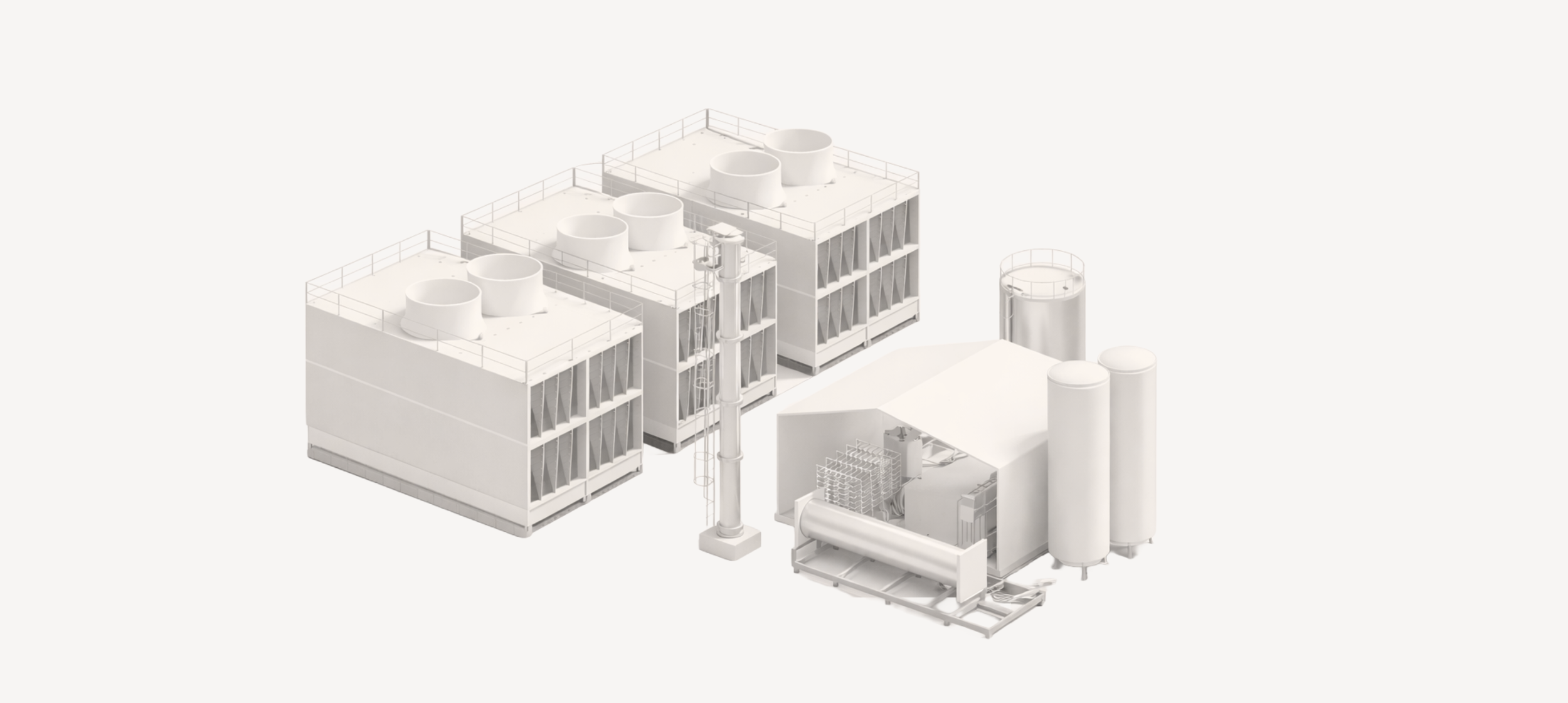
AirMyne is in the early stages of deploying DeltaDAC, the pilot demonstration project for our DAC technology.
The project will proceed through a phased deployment model that gives AirMyne, the community, and our project partners opportunities to learn and improve as we go.
Frequently Asked Questions
-
Stabilizing the climate requires progress on many fronts, especially reducing emissions associated with energy, manufacturing, and transportation. However, many essential sectors are extremely costly to decarbonize. Reducing these emissions - or, in the long run, removing CO2 that has accumulated in the atmosphere - will require require carbon dioxide removal, a suite of technologies that pull CO2 from the air. Direct air capture, or DAC, pulls CO2 from air using industrial processes in a way that complements other CDR approaches in a highly measurable way.
-
Dozens of DAC technologies are being developed to pull CO2 from air, and each is slightly different. Some use novel materials, called sorbents, that adhere CO2 molecules to their surfaces. Others use membranes or other electrochemical processes. And still others use calcium looping with high-temperature kilns. These approaches are all being tested today, yet none of them are scaling fast enough.
AirMyne tries a more practical approach. We designed our technology to use equipment and chemicals with decades of industrial use. Our process is powered mostly be low-temperature heat, allowing for easier, lower-cost energy sourcing. And from Day 1, we designed our process around a simple, safe plant design that avoids the need for high-temperatures, toxic materials, or fancy equipment.
AirMyne also has a team that knows how to make, operate, and maintain safe, functional industrial facilities. We are a team of operators, technicians, engineers, and managers, many with professional backgrounds in plant operations and safety from related industries. We know that it’s people that ultimately make a chemical plant run safely and efficiently. We need to design DAC around the needs and concerns of operators and local communities.
-
AirMyne’s technology uses industrial processes similar to those already used for decades in HVAC, water treatment, food processing, and chemical plants. By design, the chemicals we use are also used in food & beverage applications and are environmentally benign.
-
The DeltaDAC project will be built in phases. Phase 1 is an automated, integrated prototype - about the size of a truck - located at AirMyne’s headquarters, to test the system prior to outdoor demonstration. Phase 2 and 3 will bring that system to the Port of Stockon and then expand it, reaching 100-200 tons per year - the size of a few shipping containers. In Phase 4, the project will be expanded to 1,000 tons per year - in a project that has the size footprint of a small gas station, but removes CO2 instead of emitting it.
-
Any DAC technology, including AirMyne’s technology at the DeltaDAC project, uses energy. In AirMyne’s case, we need some electricity to operate fans, pumps, and a compressor, as well as heat to remove the CO2 that we’ve captured.
In the earlier phases of the project, energy demand is neglible. At Phase 3, the electricity demand would be similar to the power used by <10 homes. And a Phase 4 (1,000 tons per year), the power demand we’d require is comparable a few dozen homes.
Improving energy efficiency and pairing systems with low-carbon energy are key priorities across the industry, and this project is designed with those goals in mind.
-
Projects like this can benefit local communities in several ways. During construction, the project brings work for contractors, suppliers, and local service providers. Once operational, the facility supports skilled jobs in operations, maintenance, and potential engineering. While the total number of jobs at DeltaDAC will be modest due its small size, AirMyne intends any jobs created by this project to benefit the local community surrounding the Port of Stockton.
There are also broader benefits. By hosting an emerging climate technology project like DeltaDAC, the community can create opportunities for partnerships with local schools, universities, and workforce training programs, and they contribute to the local tax base and economic activity over time.
Overall, the goal of DeltaDAC is not only to responsibly pilot our carbon removal technology, but also to do so in a way that supports local economic activity and community engagement.
-
The project will be located at an existing industrial site in the Port of Stockton.
-
AirMyne is currently evaluating the options. In the short term, the CO2 can be sold or used, but the output volumes will be small. In the long term, CO2 could be sold for utilization or sequestered in partnership with local sequestration projects. Community engagement events will help AirMyne listen & incorporate community input related to this topic.